
What Is Burnout? A Practical Guide for Busy Professionals and High Achievers

Updated: Aug 31
Burnout Explained: Early Signs, Real Examples
Burnout gets talked about a lot these days, but most people still aren’t totally sure what it actually means. Is it stress? Exhaustion? A lack of motivation? All of the above?
To clear things up, let’s start with the academic definition of burnout, which comes from the World Health Organization (WHO).
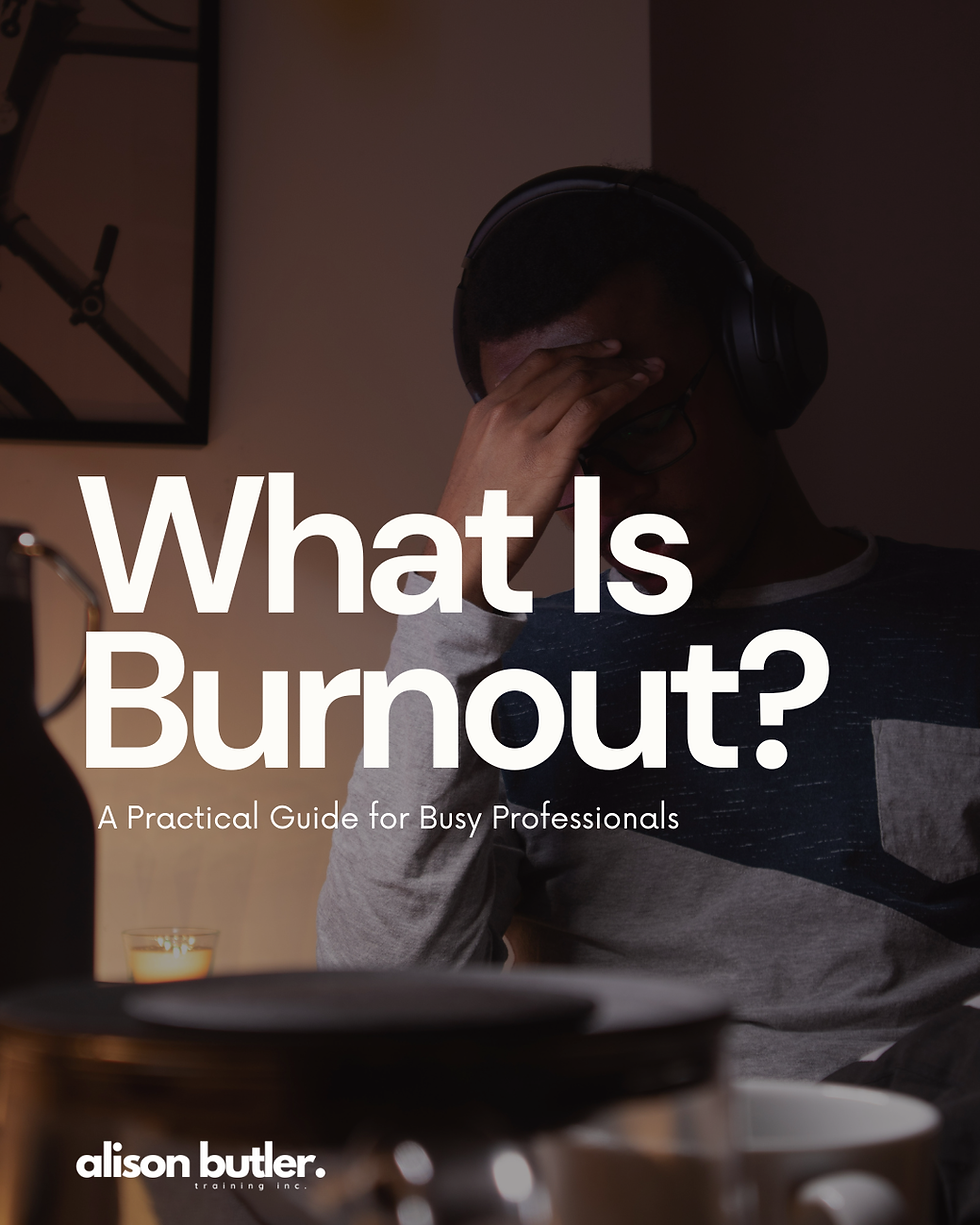
What Is the Official Definition of Burnout?
According to the WHO, burnout is a workplace phenomenon characterized by three elements:
Emotional exhaustion
Depersonalization or cynicism toward your work
Reduced professional efficacy (feeling like you’re not performing well)
That’s the formal definition.
Let’s translate it into plain language you can actually use.
What Burnout Looks Like in Everyday Work Life
Ongoing Exhaustion That Rest Doesn't Fix
This isn’t the “I stayed up too late” kind of tired.Burnout creates a deep, persistent exhaustion that sticks around no matter how much sleep you get.
Examples of exhaustion from burnout:
Waking up tired even after a “full” night’s sleep
Staring at your laptop and feeling like your brain is moving through molasses
Counting down to bedtime by mid-morning
Growing Cynicism or Detachment From Your Work
This is more than frustration. Burnout can make you feel indifferent, irritated, or emotionally numb toward your job.
Examples:
Emails feel personally offensive
You’ve stopped offering ideas in meetings
You roll your eyes at projects you once cared about
You think “What’s the point?” more often than you’d like to admit
A Decline in Performance Even If No One Notices Yet
One of the toughest things about burnout is that high achievers often hide it well.
Examples of performance-related burnout symptoms:
Tasks take twice as long
You reread the same page or email repeatedly
Small mistakes start to slip in
You feel foggy or mentally slow most days
Other Common Signs of Burnout
These aren’t part of the official definition, but they show up consistently in research and real workplaces:
Irritability or a short fuse
Feeling overwhelmed by small tasks
Increasing procrastination
Wanting to withdraw or be left alone
Feeling like you’re failing (even when you aren’t)
Reduced creativity
Difficulty relaxing or switching off after work
Why High Achievers Are More Likely to Burn Out
This is the part many people miss:
Burnout isn’t caused by weakness.
It often happens to the most capable, reliable, high-performing people.
Here’s why.
High Achievers Are Conditioned to Be “The Reliable One”
From an early age, high achievers are praised for being responsible, organized, mature, and independent.
Over time, it becomes part of their identity:
“I can handle it.”
So when burnout begins, they see exhaustion as a challenge, not a warning sign.

They're Taught to Show Up as Perfect
High achievers spend years absorbing messages like:
Don’t make mistakes
Be dependable
Work harder than everyone else
Your value comes from your output
Perfectionism becomes a coping mechanism and perfectionism is one of the strongest predictors of burnout.
Example:
You redo a presentation three times because “it could be better,” even though the first version was already strong.
They Believe They Should Be Able to Carry Everything
When high achievers hit their limits, they often blame themselves instead of the workload.
Internal monologue sounds like:
“I should be able to handle more.”
“I just need to push through.”
“Everyone else is doing fine.”
This isn’t true, high achievers simply hold themselves to unrealistic internal standards.
They Don't Want to Disappoint Anyone
High achievers tend to be helpers, team players, and problem-solvers.They take on extra tasks to protect others even when they’re overwhelmed.
But every “yes” to someone else becomes a “no” to their own capacity.
They Don't Recognize Burnout Because They're Used to Pushing Through
This is the most important thing to understand.
High achievers don’t ignore burnout.They genuinely don’t recognize it, because their baseline has always been:
Carry more
Do more
Figure it out
Push through
Burnout becomes invisible until it’s unmanageable.
The Bottom Line
Burnout is not a personal failure.It’s a psychological and physical response to prolonged, unmanaged workplace stress.
It happens when the demands you're under outweigh the resources you have for too long.
High achievers don’t burn out because they’re incapable.They burn out because they’ve been capable for so long that they forget to check in with themselves.
And the earlier it’s recognized, the easier it is to take steps that restore energy, clarity, and well-being.
Hi, I'm Alison and welcome to the blog.

Waiting for things to calm down before you start feeling like yourself again?
Here's what the research tells us: the calm doesn't come on its own.
Life By Design was created to help you stop running on empty and start feeling like you again.
Four weeks. Practical tools, Real boundaries. Support. People who get it. Join the waitlist for the next cohort.
Be sure to connect with me on IG @alisonbutlernl or on LinkedIn.


Comments